<?xml version="1.0" encoding="UTF-8"?>
<feed xmlns="http://www.w3.org/2005/Atom">
  <title type="text">Hill District Digital History</title>
  <updated>2026-04-25T14:58:28+00:00</updated>
  <generator uri="http://framework.zend.com" version="1.12.20">Zend_Feed_Writer</generator>
  <link rel="alternate" type="text/html" href="https://hillhistory.org/"/>
  <link rel="self" type="application/atom+xml" href="https://hillhistory.org/items/browse?output=rss2"/>
  <id>https://hillhistory.org/</id>
  <author>
    <name>Hill District Digital History</name>
    <uri>https://hillhistory.org</uri>
  </author>
  <link rel="hub" href="http://pubsubhubbub.appspot.com/"/>
  <entry>
    <title type="html"><![CDATA[St. Benedict the Moor School – Lasting legacy of Catholic education in the Hill]]></title>
    <summary type="html"><![CDATA[<p><img src="https://hillhistory.org/files/fullsize/5dc2aba389ec81f857e3de6212b3b610.jpg" alt="St. Benedict the Moor building" /><br/><p><strong><em></em></strong></p><p><p><span style="font-weight: 400;">The history of Catholic education in the Hill begins on July 28, 1889, when Fr. Patrick McDermott rented a house on Fulton Street in the Hill District and converted it into a church and school.&nbsp;&nbsp;</span></p>
<p><span style="font-weight: 400;">That same year the Sisters of Mercy, an international order of nuns, started a day program for education and learning at the school. The Sisters of Mercy was founded in 1831 by Catherine McAuley, and vowed to serve those who suffer from poverty, sickness and lack of education. In 1941, they began offering social services and catechetical instruction in Pittsburgh’s Hill District.</span></p>
<p><span style="font-weight: 400;">In the 1950s, the St. Richard’s School was predominantly African American. August Wilson, the Pulitzer-Prize winning playwright who grew up in the Hill, attended St. Richard’s School from third to seventh grade.&nbsp; Visiting the school years later to speak with students, he recalled that his sixth grade teacher, Sister Christopher, was the first teacher who encouraged him to pursue writing.&nbsp; He would later sponsor poetry and play writing contests for the students.</span></p>
<h5><span style="font-weight: 400;">Era of Change</span></h5>
<p><span style="font-weight: 400;">The movement of much of the white Catholic population out of the Hill in the decades after World War II had a major impact on the Catholic presence in the neighborhood. Hill Catholic parishes underwent several consolidations. St. Brigid and Holy Trinity parish were merged in 1958 after the demolition of the Holy Trinity church as part of the Lower Hill Redevelopment project. The new St. Brigid parish was itself merged with St. Benedict the Moor a decade later, to form St. Brigid-St. Benedict the Moor.</span></p>
<p><span style="font-weight: 400;">Catholic schools in the neighborhood also merged during the period, eventually consolidating as the Hill District Catholic School in 1973 at 2900 Bedford Ave. The school was not large, comprising fewer than 200 students. A Pittsburgh</span><i><span style="font-weight: 400;"> Post-Gazette</span></i><span style="font-weight: 400;"> profile in 1973 noted that Hill District Catholic’s students “are black; only one-third are Catholic, and most come from homes that statisticians would consider economically and socially disadvantaged.”&nbsp; The feature noted that many parents of limited means sacrificed to send their children to the school, believing the education to be of superior quality to the public school options available.&nbsp; Despite this, the school struggled financially; in 1975, a $20,000 budget shortage nearly resulted in its closing.</span></p>
<p><span style="font-weight: 400;">In 1977, the parishes of St. Richard’s and St. Brigid-St. Benedict the Moor eventually consolidated into one entity, establishing St. Benedict the Moor as the parish of the Hill. Hill District Catholic was rededicated as St. Benedict the Moor School in 1978.</span></p>
<h5><span style="font-weight: 400;">Financial Stability and Continued Success</span></h5>
<p><span style="font-weight: 400;">While St. Benedict school gained some financial stability in the 1980s, it still struggled to pay the bills, especially as the subsidy provided by the diocese steadily declined.&nbsp; In 1990, Pittsburgh-area corporate leaders formed the Extra Mile Foundation to raise funds for urban Catholic education, and meet the needs of poor families who depend on the Catholic schools in their neighborhoods.&nbsp; Support from the foundation has provided essential financial stability since its creation.</span></p>
<p><span style="font-weight: 400;">A 2005 independent study of the school’s graduates over the previous 10 years found a strong record of academic success at St. Benedict’s. Two-thirds of its students went on to public high school and one-third to Catholic high schools. The study found no graduate from St. Benedict the Moor School ever had to repeat ninth grade, and that 92 percent graduated from high school. More than half pursued higher education.</span></p>
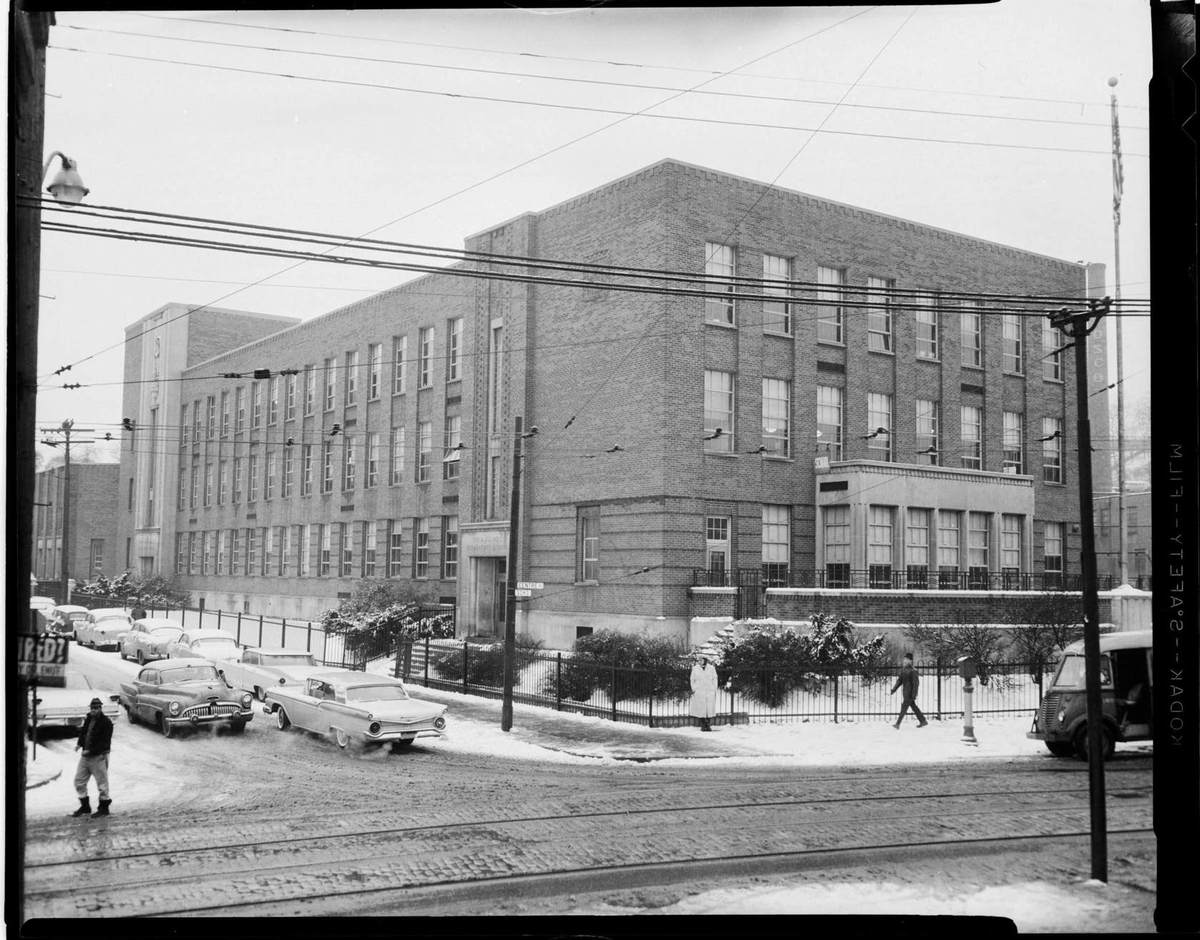
<p><span style="font-weight: 400;">In the summer of 2011, the Extra Mile Foundation purchased the vacant Robert Lee Vann Public School building at 631 Watt Street </span><span style="font-weight: 400;">for $350,000 as a new home for St. Benedict The Moor School. </span><span style="font-weight: 400;">The Vann building provided greater space to enable St. Benedict Catholic School to again expand its outreach and to start a pre-kindergarten program.</span></p>
<h5><span style="font-weight: 400;">Conclusion</span></h5>
<p><span style="font-weight: 400;">Like the Hill District itself, the story of St. Benedict the Moor Catholic School is one of resilience and perseverance. From its humble beginnings in 1889 to its transformation over the course of the 20th century, through several different names and locations, the school has served as a community beacon, providing quality education to generations of students.</span></p></p></p><p><em><strong><a href="https://hillhistory.org/items/show/66">For more (including 3 images), view the original article</a>.</strong></em></p><p></p>]]></summary>
    <published>2024-05-21T16:07:12+00:00</published>
    <updated>2025-03-17T22:01:11+00:00</updated>
    <link rel="alternate" type="text/html" href="https://hillhistory.org/items/show/66"/>
    <id>https://hillhistory.org/items/show/66</id>
    <author>
      <name>J. Roger Davis</name>
    </author>
  </entry>
  <entry>
    <title type="html"><![CDATA[Pittsburgh Weil School]]></title>
    <summary type="html"><![CDATA[<p><img src="https://hillhistory.org/files/fullsize/27fc4fff3202f391ed459066a1d3ca95.jpg" alt="Exterior of the Weil School" /><br/><p><strong><em></em></strong></p><p>The Weil School, named after prolific Pittsburgh lawyer Adolphus Leo Weil, was designed by Marion M. Steen in 1942. Members of the Hill District's arts community, including Rob Penny, August Wilson, and Sala Udin, ran the Black Horizon Theater out of Weil's auditorium. August Wilson directed several of the company's plays, which featured works from Black playwrights Amiri Baraka, Ed Bullins, and Rob Penny himself.</p></p><p><em><strong><a href="https://hillhistory.org/items/show/47">For more (including 3 images), view the original article</a>.</strong></em></p><p></p>]]></summary>
    <published>2023-11-12T18:19:01+00:00</published>
    <updated>2025-03-17T22:02:49+00:00</updated>
    <link rel="alternate" type="text/html" href="https://hillhistory.org/items/show/47"/>
    <id>https://hillhistory.org/items/show/47</id>
    <author>
      <name>The Hill District Digital History Team</name>
    </author>
  </entry>
  <entry>
    <title type="html"><![CDATA[Letsche Education Center – A Non-Traditional Approach to Education]]></title>
    <summary type="html"><![CDATA[<p><img src="https://hillhistory.org/files/fullsize/cd89b0c2ccad0d8d5c2ec5c47b84b79d.jpg" alt="Letsche School Exterior" /><br/><p><strong><em></em></strong></p><p>The Letsche Education Center, built in 1905 as the Letsche Elementary School, is an art deco building designed by architect Marian M. Steen. Originally occupying the lot at 1530 Cliff Street, a 1941 addition expanded the school to 1527 Bedford Avenue. In April of 1975, Pittsburgh's Board of Education decided to transition Letsche from an elementary school to an alternative learning center. In the years following, Letsche began to offer programs for non-traditional students: the Twelfth Grade Special Program helped students who failed to obtain the necessary number of credit hours receive their diploma; the Semester Make-Up program allowed students affected by non-academic issues to retake courses for credit; the Ed-Med program provided classes to pregnant students; and the Project Retrieval program helped to re-enroll students who have dropped out of school to raise children. The building was accepted into the National Register of Historic Places in 1986. At a 2004 meeting, members of the Pittsburgh Public School District's Board of Education voted to consolidate Letsche and the Options Center schools, with instruction continuing at the Baxter High School in Homewood North. The school officially closed sometime around 2007, remaining vacant since. In 2022, the Pittsburgh Urban Redevelopment Authority approved the sale of the Letsche building with plans to convert it into forty-two mixed income apartments. Developers will also add an addition to the property including four townhouses and a garden space.</p></p><p><em><strong><a href="https://hillhistory.org/items/show/19">For more (including 3 images), view the original article</a>.</strong></em></p><p></p>]]></summary>
    <published>2023-09-12T01:32:22+00:00</published>
    <updated>2025-03-17T22:06:25+00:00</updated>
    <link rel="alternate" type="text/html" href="https://hillhistory.org/items/show/19"/>
    <id>https://hillhistory.org/items/show/19</id>
    <author>
      <name>Alyssa Chesek</name>
    </author>
  </entry>
  <entry>
    <title type="html"><![CDATA[Connelley Trade School (Energy Innovation Center) – Educating the Steel City’s Workforce]]></title>
    <summary type="html"><![CDATA[<p><img src="https://hillhistory.org/files/fullsize/eee7cb0eafb59364b4db770c73776306.jpg" alt="Connelley Students" /><br/><p><strong><em>For 70 years, the Connelley Trade School Building served students seeking vocational education. Today, the building continues its educational legacy in innovative ways.</em></strong></p><p><div class="flex flex-grow flex-col gap-3">
<div class="min-h-[20px] flex items-start overflow-x-auto whitespace-pre-wrap break-words flex-col gap-4">
<div class="markdown prose w-full break-words dark:prose-invert light">
<p><span style="font-weight: 400;">In 1930, it was decided that a new school for vocational professions should be a part of the Pittsburgh Public School District. A construction site was chosen because it was close to downtown and accessible from central rail stations but physically high enough so that it would be above the smoke from nearby factories. The site had, since the mid-1800s, been occupied by several homes and the old Central High School building. Connelley Trade School was finished in 1931 and sits on a hilltop overlooking the Allegheny River. The school was named after Clifford B. Connelley (1863-1928), who was a school dropout and messenger boy who rose to become a city council member and a prominent member of the Pennsylvania Commission of Labor and Industry. Connelley had been an advocate for the expansion of vocational education across the state.</span></p>
<h3><span style="font-weight: 400;">Facilities to Serve the Steel City</span></h3>
<p>Once construction was completed in 1931, Connelley was the largest building of its type in the state. It boasted features such as a 75-meter swimming pool, gyms, and a full-service kitchen for both education and a delicious lunch. However, Connelley's amazing classrooms were the real focus. It boasted carpentry, plumbing, and plastering classrooms. The complex also had sheet metal workshops, auto-mechanic shops, and radio operating laboratories. The building was so large, and classrooms so gigantic, that interior hallways could fit whole trucks within them to facilitate the delivery of materials and the removal of student work.</p>
<h3><span style="font-weight: 400;">The War Years</span></h3>
<p>As the drums of war began to beat in Europe, Pittsburgh stepped into its role as part of the Arsenal of Democracy. Connelley led the way in educating Pittsburgh's young workers on the production of war materials. The pre-war period became Connelley's peak. In the 1939-1940 school year, attendance peaked at 1,800 students when the school had been built for 1,600.</p>
<p>During the war, welding and machine shops ran two shifts a day to train students in the production of guns, planes, tanks, and bombs. In the following decades, the wars hurt enrollment, but returning veterans of World War II, Korea, and Vietnam went to Connelley in search of new beginnings. These new students put their skills to excellent use. For example, a student-created mirror ball was used in school dances across the 1950s. During this period, Connelley's students built toy trains, printed cookbooks, and found other ways to fundraise for the local community.</p>
<h3><span style="font-weight: 400;">The Turbulant 1960s</span></h3>
<p>During the 1950s, the City of Pittsburgh planned a large urban redevelopment project that would tear down the Lower Hill District (which Connelley was located on the edge of) and replace it with a new "Civic Arena." By 1960, the citizens of the Hill District fought back and held back the redevelopment at the middle hill, but much of the local population that Connelley served had been wiped out.</p>
<p>At the turn of the 1960s, Connelley, like all schools in Pittsburgh and the United States, dealt with the issue of desegregation. While U.S. schools were desegregated by the Supreme Court in 1954, segregation continued in de facto practice afterward. In 1961, the case Taylor vs. Board of Education of City School District of New Rochelle declared that de facto segregation in school districts to be unconstitutional. This resulted in a period of racial tension in Pittsburgh schools as about 900 black students were transferred to white majority schools. However, school-to-school inequality remained high. At Connelley, it was decided that as the 1970s began, budget cuts would make Connelley a paid program only.</p>
<h3><span style="font-weight: 400;">A Diverse Student Body and Faculty</span></h3>
<p>Connelley served students from across the Pittsburgh area. Many of these students were underperforming at traditional schools or were just seeking vocational training. Harry Habay, from the class of 1944, took hours to hitchhike from his native West Deer all the way to the Hill District to attend Connelley. Newcomers to Pittsburgh were also students of Connelley; many students attended simply to learn how to speak English as a second language. In the 1960s and 70s, these classes were free of charge; however, by the 1990s, due to state budget cuts, the sticker shock of a new $650 dollar-a-semester price tag led to dwindling attendance.</p>
<p>Some students remember the faculty truly being the most impressive part of Connelley. For instance, Lee Hebermann, who graduated in 1959, was motivated by the high expectations of teachers like Savero DonGiovanni, who pushed him to stay in school and to later pursue goals above and beyond being a mechanic. DonGiovanni would later become vice-principal.</p>
<h3><span style="font-weight: 400;">The End of Connelley and A New Start</span></h3>
<p>In 2003, enrollment at Connelley had fallen to 730. The following year, $2.5 million in state budget cuts for vocational programs made Connelley unsustainable for Pittsburgh Public Schools. In 2004, the school board voted to close Connelley Trade School after 70 years of operation.</p>
<p>While the building was left vacant, plans began to circulate for a new use for the building. In 2013, part of future Mayor Bill Peduto's campaign included a plan for a "Pittsburgh Connelley for the 21st century." Upon election, Peduto worked with the non-profit developer, Pittsburgh Gateway Corporation, to develop the site for the 21st century. In 2015, at the cost of $47 million dollars, the Energy Innovation Center opened. Inside what was formerly Connelley's complex, The Innovation Center is an office and education space that boasts LEED certified green infrastructure. These amenities include stormwater absorbing trees, electric vehicle charging stations, and a 40-foot wind turbine with enough strength to power the average U.S. four-family household. Today, the Energy Innovation Center brings the spirit of education and innovation of the Connelley Trade School into the 21st century.</p>
</div>
</div>
</div></p></p><p><em><strong><a href="https://hillhistory.org/items/show/11">For more (including 7 images), view the original article</a>.</strong></em></p><p></p>]]></summary>
    <published>2023-07-26T20:05:59+00:00</published>
    <updated>2025-06-18T19:11:47+00:00</updated>
    <link rel="alternate" type="text/html" href="https://hillhistory.org/items/show/11"/>
    <id>https://hillhistory.org/items/show/11</id>
    <author>
      <name>Zach Cene</name>
    </author>
  </entry>
</feed>