<?xml version="1.0" encoding="UTF-8"?>
<feed xmlns="http://www.w3.org/2005/Atom">
  <title type="text">Hill District Digital History</title>
  <updated>2026-04-25T14:58:28+00:00</updated>
  <generator uri="http://framework.zend.com" version="1.12.20">Zend_Feed_Writer</generator>
  <link rel="alternate" type="text/html" href="https://hillhistory.org/"/>
  <link rel="self" type="application/atom+xml" href="https://hillhistory.org/items/browse?output=rss2"/>
  <id>https://hillhistory.org/</id>
  <author>
    <name>Hill District Digital History</name>
    <uri>https://hillhistory.org</uri>
  </author>
  <link rel="hub" href="http://pubsubhubbub.appspot.com/"/>
  <entry>
    <title type="html"><![CDATA[Jewish Synagogues – Jewish Life in The Hill]]></title>
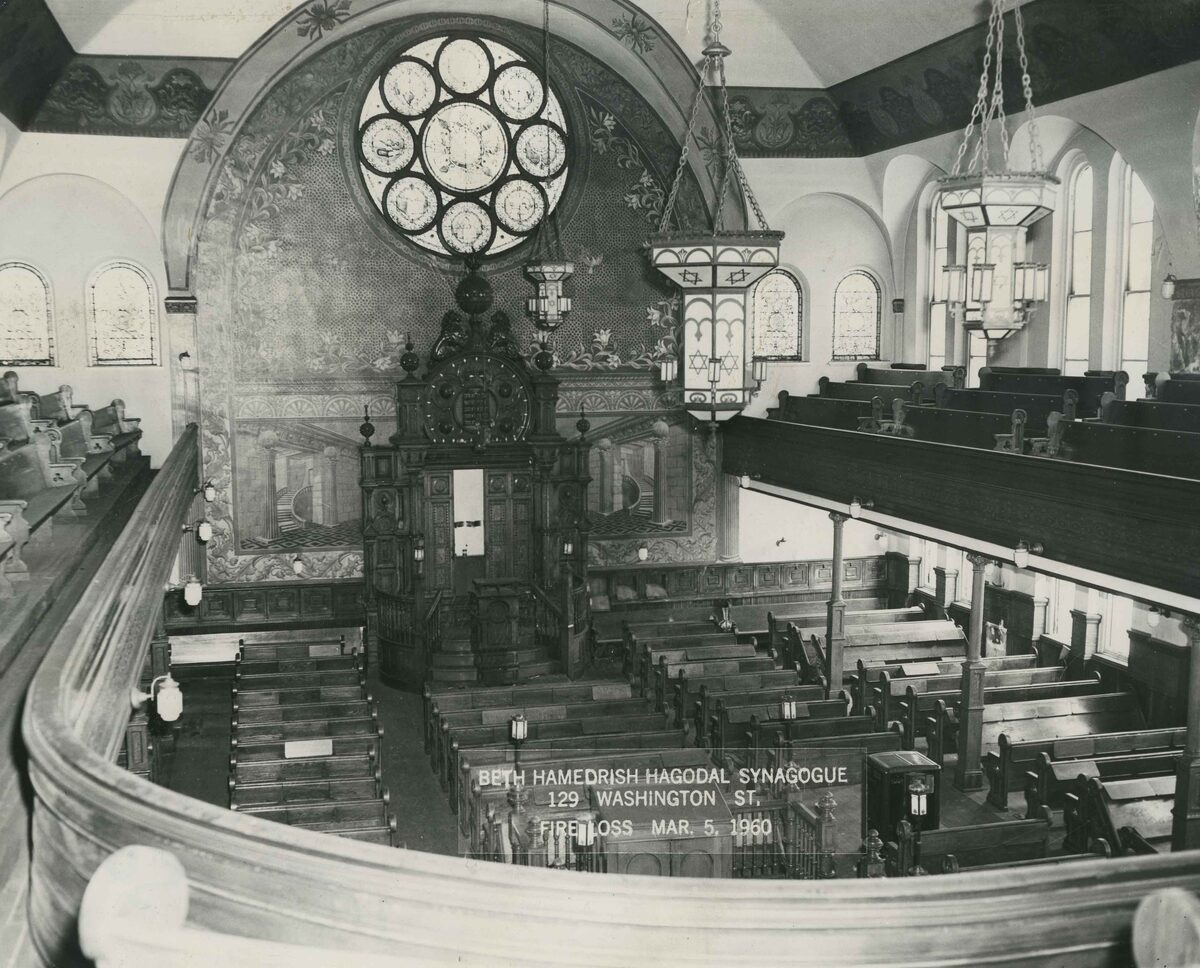
    <summary type="html"><![CDATA[<p><img src="https://hillhistory.org/files/fullsize/1210af56cde4f6d6d7f55049a78b1c19.jpg" alt="Beth Hamedrash Hagodol (Washington Street), interior" /><br/><p><strong><em></em></strong></p><p>Jews have been present in the territory that would eventually become the city of Pittsburgh almost since the beginning. Some of the first recognizable settled Jews were David Franks, Levi A. Levy, and William Trent, who manned a permanent trading post in the settlement at the forks of the Ohio River in 1760. From these early roots, the Jewish presence in Pittsburgh gradually grew, becoming an integral part of the city's evolving cultural and social fabric.</p><p>The Jewish population of Pittsburgh&nbsp; since then has been a small but steady presence in the city’s history. While mostly associated with Squirrel Hill today, the center of Jewish life in Pittsburgh was formerly the Hill District. In fact, the Jewish community of the Hill was an even older community than that of Squirrel Hill. This transformation in Jewish settlement patterns becomes particularly striking when examining the once-thriving Jewish community of the Hill District.</p><p>While the Hill District is often more associated with the African-American population of Pittsburgh, 20 synagogues stood within its limits between 1890 and 1925. The majority of the Hill’s Jewish population consisted of Eastern European Jews who migrated to the United States in the latter half of the 19th Century, starting in the 1870s and continuing till just after the First World War. As the center of Jewish spiritual and community life, synagogues soon sprouted up. The expansion of synagogues in the Hill District serves as a testament to the centrality of religious and community life for these Jewish immigrants.</p><p>Building off of practices established in Germany and Eastern Europe, many of these synagogues were simple and temporary affairs established in the backs of houses and businesses, however a few larger brick and mortar synagogues would be established. One of the more noteworthy being Beth Hamedrash Hagodol-Beth Jacob Congregation. Founded under a different name by Lithuanian Jewish Immigrants in 1869, it would later move locations and rename itself in 1892. Beth Hamedrash Hagodol-Beth Jacob was an Orthodox Synagogue (a Traditionalist Branch of Judaism) and was the self-proclaimed center of Orthodox Judaism in Greater Pittsburgh. Despite their modest beginnings, some of these synagogues evolved into enduring institutions that played pivotal roles in shaping Pittsburgh's Jewish identity.</p><p>Another notable Synagogue was Kether Torah, another Orthodox Congregation established around the same time as Beth Hamedrash Hagodol-Beth Jacob. Kether Torah was a smaller congregation and at the time sponsored a Jewish Cemetery in the Hill District. While they separated in the 1960s as Pittsburgh’s Jews moved into the suburbs and wealthier neighborhoods like Squirrel Hill thanks to both growing financial capabilities of Pittsburgh Jews and the repeals of many red line laws for Jews after World War II and Jewish religious law requiring Synagogues to be close to the Jewish places of living, both the Congregation and the original structure have survived though the building that once housed the Kether Torah Synagogue is now a Christian Church. Kether Torah’s story offers another perspective on the religious and cultural adaptation of the Hill District's Jewish community, paralleling the narrative of Beth Hamedrash Hagodol-Beth Jacob.</p><p>The Story of Beth Hamedrash Hagodol-Beth Jacob Synagogue is similar in that they also moved as a congregation out of the Hill in the 1960s and after a series of moves ended up at its current location on 5th Avenue. Like countless other businesses, homes, and religious structures, the Original Synagogue was purchased under eminent domain and demolished along with much of the Hill with the Urban Renewal Projects of the 60s. Yet, the story of these synagogues also underscores the broader social and economic shifts that led to the gradual decline of the Hill District as a center of Jewish life.</p><p>The Jews of the Hill District largely left the Hill during this period and resettled in Squirrel Hill and Oakland starting in the 50s and have largely abandoned the Hill despite its significance as the former center of Jewish life in Pittsburgh however in the institutional memory of many Pittsburgh Synagogues and in some buildings still standing in the Hill, that history can still be seen. While the Jewish presence in the Hill District has diminished, the area remains a poignant reminder of its historical significance to Pittsburgh’s Jewish community.</p></p><p><em><strong><a href="https://hillhistory.org/items/show/76">For more, view the original article</a>.</strong></em></p><p></p>]]></summary>
    <published>2024-12-11T17:44:13+00:00</published>
    <updated>2025-03-17T21:59:53+00:00</updated>
    <link rel="alternate" type="text/html" href="https://hillhistory.org/items/show/76"/>
    <id>https://hillhistory.org/items/show/76</id>
    <author>
      <name>Alex Tiller</name>
    </author>
  </entry>
  <entry>
    <title type="html"><![CDATA[St. Benedict the Moor Church – Historic home of Pittsburgh's Black Catholic community]]></title>
    <summary type="html"><![CDATA[<p><img src="https://hillhistory.org/files/fullsize/1fc7ca50a9a2036755b10f654573e9af.jpg" alt="Statue of St. Benedict the Moor" /><br/><p><strong><em><span style="font-weight: 400;">For over a century, Pittsburgh’s Black Catholics have found a literal sanctuary at St. Benedict the Moor, a church named for the patron saint of African Americans.</span></em></strong></p><p><p><span style="font-weight: 400;">The late 19th century saw the emergence of the “Colored Conventions” movement - a series of national conventions organized by Black leaders and focused on a variety of social and political issues.&nbsp;</span></p>
<blockquote>As many of the Hill District’s older white residents left the neighborhood, St. Benedict the Moor’s clergy and the Diocese listened and learned how to adapt the liturgies for Black traditions, including a gospel choir which performs weekly.</blockquote>
<p><span style="font-weight: 400;">Among these was the Colored Catholic Congress, first held January 1889 in Washington, DC to address racial discrimination within the American Catholic church.&nbsp; Moved by these efforts, Fr. Patrick McDermott, CSSp, created a mission as part of the Pittsburgh Catholic College of the Holy Ghost (now Duquesne University) in July 1889. The Black parish met in several church buildings through the years, until in 1962 the Diocese of Pittsburgh reopened the former Holy Trinity Church building as a new permanent home for St. Benedict the Moor parish. <br /></span></p>
<p><span style="font-weight: 400;">At the time of the move, the Hill District was still trying to rebuild its community and find a way forward from the destruction wrought by the city’s Urban Redevelopment Authority when it cleared much of the Lower Hill during the late 1950s for the construction of the city’s Civic Arena. The corner of Centre Avenue and Crawford Street became the “line drawn in the sand” for Hill residents, who organized to prevent further clearance and redevelopment of the Hill at a place now known as <a href="https://hillhistory.org/items/show/7">Freedom Corner</a>. St. Benedict the Moor Church became a symbolic landmark as Black Pittsburghers of all faiths and their allies rallied and marched for equality and civil rights protections from the church's front steps.<br /></span></p>
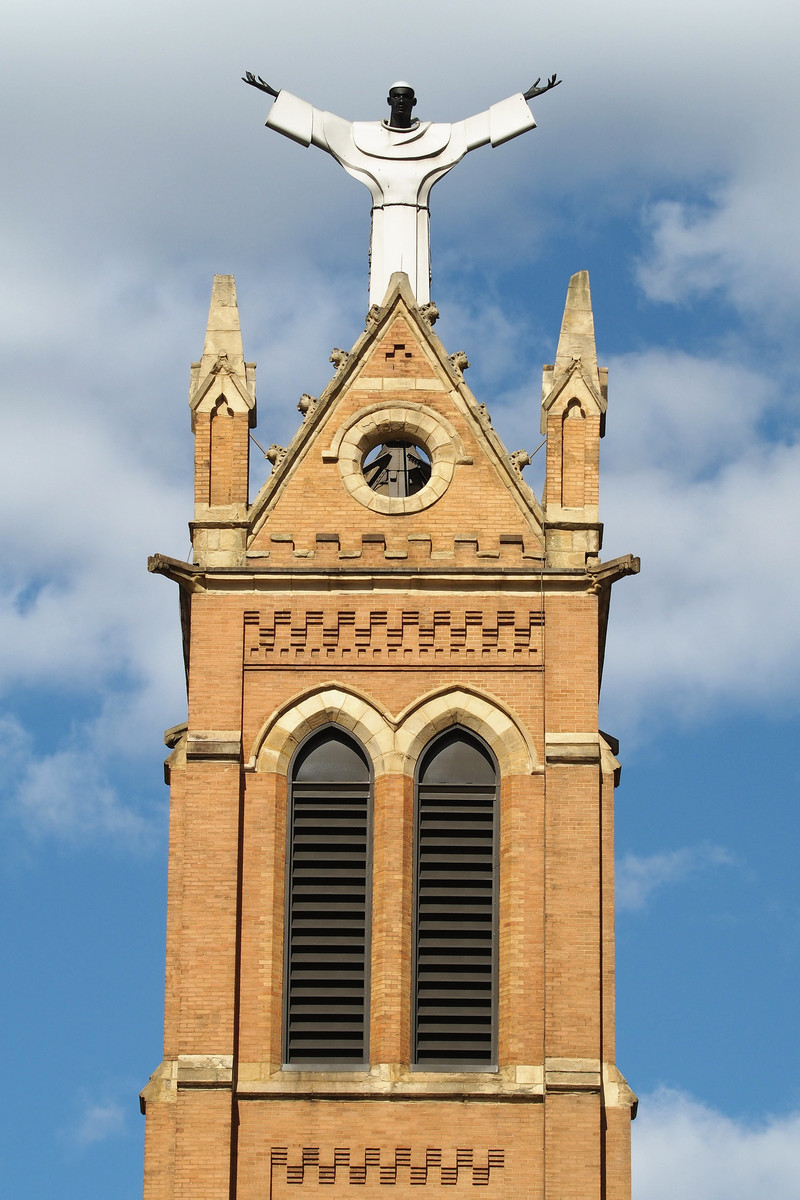
<p><span style="font-weight: 400;">In late 1968, the Diocese of Pittsburgh installed the eighteen-foot-tall statue of</span> <span style="font-weight: 400;">St. Benedict the Moor</span><span style="font-weight: 400;"> atop the church’s bell tower. St. Benedict the Moor was born as Benedetto Manasseri near Messina, Italy. His parent were Africans who had been enslaved in the early 16th Century and taken to San Fratello, a part of the region of Sicily, Italy. Although persecuted because of his race, he became known for generosity, feeding the hungry, and conducting miracles. The statue was commissioned by Bishop John Wright and funded through a donation from an “anonymous Protestant donor of one of Pittsburgh’s oldest families.” Sculpted by </span><span style="font-weight: 400;">Frederick Charles Shandy</span><span style="font-weight: 400;">, the statue depicts St. Benedict facing the Golden Triangle with arms spread wide.&nbsp; The symbolism of the statue has been interpreted in various ways - some intepret it as a rebuke of downtown and its neglect of the Hill, while others argue the statue is in a posture of welcoming and embrace.</span><span style="font-weight: 400;"> "At the precise boundary between these two worlds," said Rev. John Wright, bishop of Pittsburgh, in 1968, "the hands of a black Christian saint, St. Benedict the Moor, will be lifted in gestures of forgiveness, prayer, and peace over the Pittsburgh community."&nbsp;<br /></span></p>
<p><span style="font-weight: 400;">As many of the Hill District’s older white residents left the neighborhood, St. Benedict the Moor’s clergy and the Diocese listened and learned how to adapt the liturgies for Black traditions, including a gospel choir which performs weekly. St. Benedict the Moor was also the first parish in the Diocese of Pittsburgh to be assigned a Black priest, Fr. Augustus Taylor, Jr. </p><p>In addition to serving the Hill, the parish draws worshippers from throughout Greater Pittsburgh. This geographic reach is generally unheard of in the Catholic faith, where parishes are typically based upon physical residence. The Diocese had merged St. Benedict the Moor with two other parishes at the beginning of 2020, but this move was met with resistance from St. Benedict the Moor’s parishioners.&nbsp; Both clergy and the congregation saw an opportunity to preserve their traditions and petitioned the diocese to recognize St. Benedict the Moor as a “personal parish”, which distinguishes a parish with traditions additional to the usual mass structures. Bishop David Zubik approved the petition and recognized the personal parish of St. Benedict the Moor on July 13, 2020.</span></p></p></p><p><em><strong><a href="https://hillhistory.org/items/show/44">For more (including 4 images), view the original article</a>.</strong></em></p><p></p>]]></summary>
    <published>2023-10-17T13:32:02+00:00</published>
    <updated>2025-03-17T22:03:23+00:00</updated>
    <link rel="alternate" type="text/html" href="https://hillhistory.org/items/show/44"/>
    <id>https://hillhistory.org/items/show/44</id>
    <author>
      <name>Amy Brunner</name>
    </author>
  </entry>
  <entry>
    <title type="html"><![CDATA[Central Baptist Church – Faith and Activism in the Hill]]></title>
    <summary type="html"><![CDATA[<p><img src="https://hillhistory.org/files/fullsize/b9305e405697c49d6c1897b469e6afe0.jpg" alt="Congregation of Central Baptist" /><br/><p><strong><em></em></strong></p><p>Throughout the 111 years that Central Baptist Church has stood at 2200 Wylie Avenue, it has offered the residents of the Hill District a strong Black religious presence in the neighborhood which has uplifted the whole community. Though the church has had its struggles over the decades, the devoted leaders which have pastored it have continually made Central Baptist into a church body which serves the Hill both socially and spiritually.<br />
<h3><span style="font-weight: 400;">Difficult Beginnings</span></h3>
<br />Formed in 1891, Central Baptist purchased its building on the corner of Kirkpatrick and Wylie in 1912, and has stayed there ever since. The church’s first years were uneventful until it began experiencing severe financial difficulties during the tenure of its sixth pastor, Dr. Rev. C.A. Ward, likely due to the economic hardships brought to the Hill by the Great Depression. The situation was made even worse when the church building caught fire from unknown causes in 1934, which required significant efforts to rebuild. According to one Courier article, the church’s debts were so large in the late thirties that they were “‘choking’ the life and spirit” from its congregation. Though Rev. Ward attempted to resign, the church board decided against it, and Central Baptist did not receive a new pastor until the reverend passed away in 1937. </p><p>His successor, Rev. Cornell E. Talley, was one of the most beloved pastors the church ever had. A relatively young man for his trade at just 31 years old, Talley arrived from Indianapolis with his wife and eight month old son, and preached his first sermon at Central Baptist in 1938. Within just three years, he tripled the church’s attendance from 532 regular members to 1,500, and he not only managed to pay off all of Central Baptist’s debts, but increased the church’s savings to $5,000. </p><p>This kind of growth was unheard of for the church previously, but the church’s rocky history seemed not to bother Rev. Talley. He was known for his motto, “Forgetting those things which were behind, and reaching forth unto those things which are before.” Under his leadership this became the guiding vision behind Central Baptist, inspiring their participation in the struggle for Black freedoms.<br />
<h3><span style="font-weight: 400;">Fighting for Rights</span></h3>
<br />The church at this time took an active role in the civil rights movement, hosting several NAACP rallies in support of activists in the South and at home. They even hosted NAACP chief counsel Thurgood Marshall in 1950, just a few years before his landmark victory in <em>Brown v. Board</em> and his historic tenure as the first African American Supreme Court Justice. </p><p>Dr. Martin Luther King came to visit on several occasions, leading services of worship at the church as well as delivering his “A Knock at Midnight” speech there. When Rev. Talley took a position with another church in 1961, Dr. King was even considered as a candidate in the church’s search for a new pastor. </p><p>Talley's resignation was vigorously protested by many of the congregation’s members, a testament to how much he was cherished as the pastor there. He was succeeded by Dr. Isaac Green, who led Central Baptist from 1963 to 1994, and saw the church through endeavors like their first televised services and the creation of the Central Baptist Academy. The church’s current pastor, Rev. Victor Grigsby, has continued Central Baptist’s legacy of community service and activism, even holding a rally to support former President Barack Obama’s campaign in 2008.</p></p><p><em><strong><a href="https://hillhistory.org/items/show/27">For more (including 4 images), view the original article</a>.</strong></em></p><p></p>]]></summary>
    <published>2023-09-27T00:19:55+00:00</published>
    <updated>2025-06-21T18:54:37+00:00</updated>
    <link rel="alternate" type="text/html" href="https://hillhistory.org/items/show/27"/>
    <id>https://hillhistory.org/items/show/27</id>
    <author>
      <name>Nolan Cowan</name>
    </author>
  </entry>
  <entry>
    <title type="html"><![CDATA[St. George Syrian Antiochian Orthodox Church]]></title>
    <summary type="html"><![CDATA[<p><img src="https://hillhistory.org/files/fullsize/a20f4bcf0c610374ab3d187d5d0b65a1.jpg" alt="Church exterior" /><br/><p><strong><em></em></strong></p><p>This small, yellow brick church, topped with a traditional orthodox onion dome, served as a spiritual home for Pittsburgh's Syrian, Lebanese, and Palestinian communities from 1917 to 1959. It was during this time that August Wilson, who wrote the famous "Pittsburgh Cycle," frequently spent time on the chapel steps with other Hill District youth. Following the congregation's move to Oakland in 1959, various Protestant groups used the church as a space for worship.</p></p><p><em><strong><a href="https://hillhistory.org/items/show/26">For more, view the original article</a>.</strong></em></p><p></p>]]></summary>
    <published>2023-09-27T00:18:24+00:00</published>
    <updated>2025-06-20T16:55:06+00:00</updated>
    <link rel="alternate" type="text/html" href="https://hillhistory.org/items/show/26"/>
    <id>https://hillhistory.org/items/show/26</id>
    <author>
      <name>The Hill District Digital History Team</name>
    </author>
  </entry>
  <entry>
    <title type="html"><![CDATA[Bethel African Methodist Episcopal Church – Resilience and Revitalization in the Hill]]></title>
    <summary type="html"><![CDATA[<p><img src="https://hillhistory.org/files/fullsize/9579d9248f865eb9bd1c2624d9a6d05b.jpg" alt="Bethel A.M.E. Church on 1206 Wylie Avenue, now torn down" /><br/><p><strong><em>An institution focused on faith, service, and activism, Bethel AME is a testament to the enduring spirit of Pittsburgh's Black community.</em></strong></p><p>The Bethel African Methodist Episcopal Church in Pittsburgh recently signed a deal with the Pittsburgh Penguins hockey team to recuperate its historic land. But why was this deal necessary? Under a program known as "urban renewal" in the 1950s, Pittsburgh city leaders ordered Bethel AME and many other historic buildings to be demolished to make way for the Civic Arena. Today, Bethel fights for its return to the neighborhood it called home. Yet this glimpse only tells a fraction of the church's story. To truly understand the modern context, the church's powerful history spanning the 1800s and 1900s needs to be understood. Through its social and spiritual history, Bethel AME Church greatly impacted the Lower Hill neighborhood and its African American community.<br />
<h3><span style="font-weight: 400;">Early Activism</span></h3>
<br />In the nineteenth century, Bethel played a vigorous role in black civil rights. Originally known as the "African Church," black residents created it in 1808 as a non-denominational church to support their small community. The church's recruitment quickly expanded as more black Americans arrived in Pennsylvania, since the state offered a safe haven for escaped slaves. In order to properly organize their membership, the church officially affiliated with the African Methodist Episcopal Church in 1818. The AME Church formed as a national anti-slavery organization; in other words, the church supported escaping slaves in the Underground Railroad, opposed the African colonization movement, and bolstered black suffrage and education. </p><p>Through these political goals, Bethel AME in Pittsburgh joined a united movement dedicated to black civil rights, and actively participated in that movement. Under the leadership of Reverend Lewis Woodson, the Pittsburgh church itself became a stop on the Underground Railroad to help escaping slaves. Reverend Woodson soon led the church to form the city's first school for black children in 1831. Additionally, as the movement expanded throughout Pennsylvania, Bethel AME hosted the state's civil rights convention in 1841. </p><p>During the turbulence of Reconstruction, the national AME Church sent missionaries to help protect the rights of the newly freed African Americans of the South. Black Pittsburgh residents regularly participated in this missionary work. One Pittsburgh Courier article proudly cites the service history of the city's men and women, including local missionary president Harriet White and "young people's department" director Elsie Meeks as recently as 1953. </p><p>The national AME Church also pushed for black representation and justice in American history, as a significant actor in the 1876 centennial celebrations. Representatives like Christian Recorder editor Benjamin Tucker Tanner advocated for events celebrating black history, including memorials of African American military service, religious liberty, and new monuments to black spiritual leaders like African Methodist founder Richard Allen. </p><p>Within this coalition, Bethel AME remained a powerful force for black civil rights in Pittsburgh. Reverend J. W. Gazaway, pastor of Bethel AME, provides a perfect example of black leadership in the city. In 1898, Gazaway spoke out against the trend of lynching black men, and served his community as a spiritual advisor to black Americans imprisoned in an unfair criminal justice system. Through their efforts at black education, suffrage, civil rights, and spiritual support, the leaders of Bethel AME played a key role in black civil rights in the 1800s. <br />
<h3><span style="font-weight: 400;">20th Century Challenges</span></h3>
<br />Moving into the twentieth century, the national AME organization faced new challenges affecting the Pittsburgh church. Over two decades, several black denominations splintered into different factions with disparate goals, and Pittsburgh remained in the center of this debate. Bethel AME hosted a conference for these denominations to unite in common interests and proposed the Pittsburgh Plan for Unification in 1927. The Colored Methodist Episcopal, African Methodist Episcopal, and African Methodist Episcopal Zion churches all wanted an equal balance of leadership and structure, to ensure no single denomination would absorb the others in the potential merger. While these factions ultimately remained separate, this illustrates another example of Bethel's authority on the national stage, which continues through the modern civil rights movement.</p><p>Beyond its wide range of influence, Bethel has provided a welcoming respite to generations of African Americans in Pittsburgh. By 1962, Reverend J. G. Harris found that "the vineyard is richer" as the pews of his church filled with more educated, active members. <em>Pittsburgh Courier</em> writer Theodore Graham reported this steadily growing church membership owed its success to the caring involvement of church leaders in all facets of life, including "housing, labor, community problems, and politics." With such passion for advocacy, Bethel church members knew their leaders would speak out to protect their interests. </p><p>Bethel also stands strong as an institution that feels like a second home to its members.
<blockquote>Bethel has provided a welcoming respite to generations of African Americans in Pittsburgh.</blockquote>
In addition to weekly Sunday services and Wednesday Bible Study and Church School groups, churchgoers have always joined together to celebrate their house of faith. Over decades, members organized anniversary celebrations of the church's founding, including banquets where key community leaders remembered Bethel's role in their lives. These reverent speeches came from influential men and women, such as Judge John Drew of the Common Pleas Court in 1953. During a report on one well-attended banquet, Courier religious editor Bert Logan examined the history of Bethel's charitable entrepreneurs, highlighting a spirit of caring philanthropy. Bethel AME Church acted as a vibrant part of life in the Lower Hill.<br />
<h3><span style="font-weight: 400;">Urban Renewal Era</span></h3>
<br />Unfortunately, during the 1950s, the church's neighborhood came under attack. Relying on environmental language of urban "blight" or a decaying landscape, the Urban Redevelopment Authority of Pittsburgh pursued a program of "urban renewal" and demolished the historically black Lower Hill District. This trend occurred across American cities of the postwar era and aimed to remove poor, declining, and largely minority neighborhoods and replace them with new commercial development. More than 8,000 residents were evicted from the Lower Hill, and many of the businesses and institutions were lost or destroyed.</p><p>After decades of civil rights activism to restore their community, black Pittsburgh residents established major breakthroughs. Twenty-first century activism has produced a legacy of community engagement, including community benefits agreements to guarantee black residents will have a say in projects involving economic development. Within this activism, Bethel AME persists as a community leader, offering a space for change.<br />
<h3><span style="font-weight: 400;">Recent Developments</span></h3>
<br />In April 2023, a great deal of the Pittsburgh press focused on Bethel's story. Through a comprehensive agreement between the Pittsburgh Penguins legal team and the leaders of Bethel AME, new plans are underway to create new housing, a childcare facility, and a commercial zone in the Lower Hill. These public relations initiatives demonstrate how Bethel endures as a vital authority in the memory of Pittsburgh's black community. Despite the shifting physical locations of the Bethel AME Church in Pittsburgh, it has remained an eminent source of strength in the Hill community for over two centuries. The spiritual and social power of this house of faith transcends place and time.</p></p><p><em><strong><a href="https://hillhistory.org/items/show/9">For more, view the original article</a>.</strong></em></p><p></p>]]></summary>
    <published>2023-07-26T12:57:36+00:00</published>
    <updated>2025-06-01T01:09:35+00:00</updated>
    <link rel="alternate" type="text/html" href="https://hillhistory.org/items/show/9"/>
    <id>https://hillhistory.org/items/show/9</id>
    <author>
      <name>Joseph Naughton</name>
    </author>
  </entry>
</feed>