<?xml version="1.0" encoding="UTF-8"?>
<feed xmlns="http://www.w3.org/2005/Atom">
  <title type="text">Hill District Digital History</title>
  <updated>2026-04-25T14:58:23+00:00</updated>
  <generator uri="http://framework.zend.com" version="1.12.20">Zend_Feed_Writer</generator>
  <link rel="alternate" type="text/html" href="https://hillhistory.org/"/>
  <link rel="self" type="application/atom+xml" href="https://hillhistory.org/items/browse?output=rss2"/>
  <id>https://hillhistory.org/</id>
  <author>
    <name>Hill District Digital History</name>
    <uri>https://hillhistory.org</uri>
  </author>
  <link rel="hub" href="http://pubsubhubbub.appspot.com/"/>
  <entry>
    <title type="html"><![CDATA[Hill House Association – "The Heart of the Hill"]]></title>
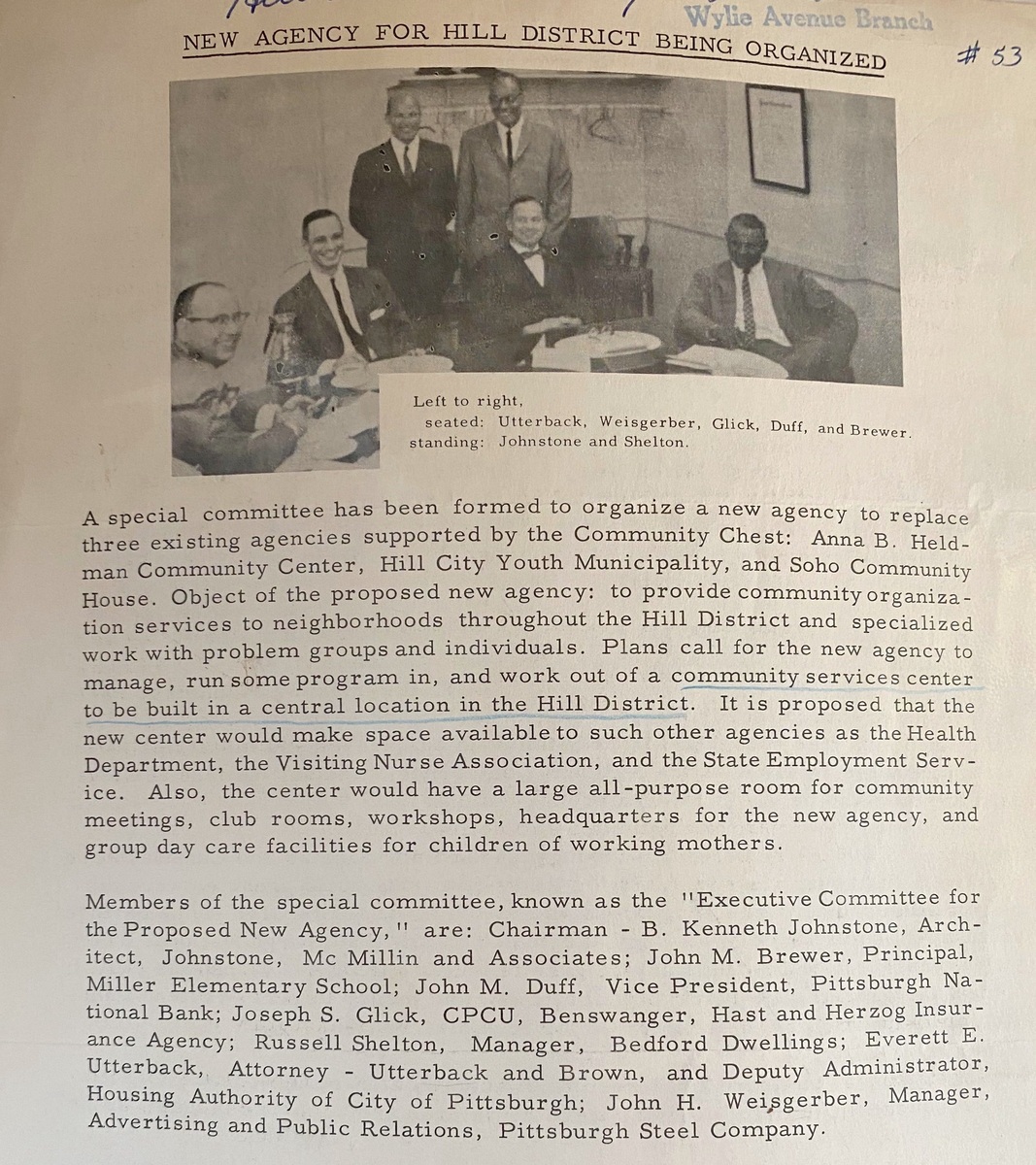
    <summary type="html"><![CDATA[<p><img src="https://hillhistory.org/files/fullsize/bfa529fe43620ce2fff5efc121a28c71.jpg" alt="Origins of Hill House" /><br/><p><strong><em></em></strong></p><p>The Hill House Association served as a community development organization and played a vital role in the Hill for more than 50 years.&nbsp; Hill House formed in 1964 from the merger of three pre-existing organizations: the Soho Community Center, the Anna B. Heldman Center, and the Hill City Youth Municipality. </p><p>In 1972, the Hill House’s new headquarters was completed on Centre Avenue. In addition to health and human service agencies, the association offered personal development classes on site. </p><p>The organization was closely intertwined with the Hill District's Black community; the building itself was designed by Black architect Walter Lenox Roberts Jr., and many of the association's managers and tenants were Black leaders.</p><p>The bureaucratic aspects of Hill House are briefly mentioned in an exchange in August Wilson's <em>Radio Golf</em>.<br />
<blockquote>"They tell you, 'Sit over there and wait.' 'Fill out this&nbsp; paper.' 'Turn over.' 'Jump up and down.' I tried to tell them I wasn't no dog but they wasn't listening." <b>-Old Joe, <em>Radio Golf</em></b></blockquote>
<br />In 2019, mounting debt and electrical damage to the building led to the dissolution of the Hill House Association. Medical offices continue to operate out of the building.</p></p><p><em><strong><a href="https://hillhistory.org/items/show/45">For more, view the original article</a>.</strong></em></p><p></p>]]></summary>
    <published>2023-11-12T14:47:34+00:00</published>
    <updated>2025-03-17T22:03:07+00:00</updated>
    <link rel="alternate" type="text/html" href="https://hillhistory.org/items/show/45"/>
    <id>https://hillhistory.org/items/show/45</id>
    <author>
      <name>The Hill District Digital History Team</name>
    </author>
  </entry>
  <entry>
    <title type="html"><![CDATA[Irene Kaufmann Settlement – Born from tragedy to provide comfort and community to thousands of Hill District families]]></title>
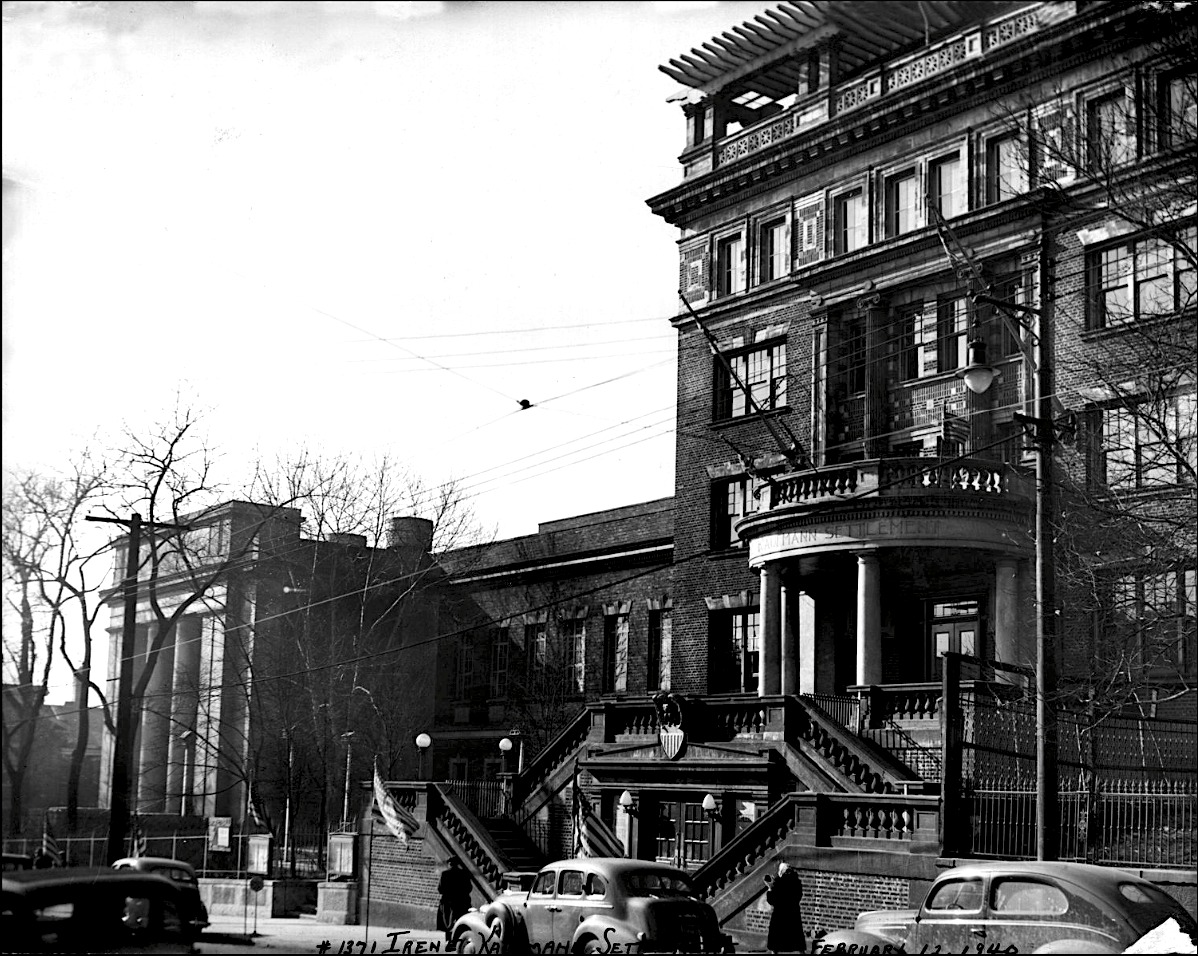
    <summary type="html"><![CDATA[<p><img src="https://hillhistory.org/files/fullsize/dd9019cf8e865d59276a3aa3a3d9d1f7.jpg" alt="View of the Irene Kaufmann Settlement" /><br/><p><strong><em></em></strong></p><p><h3><span style="font-weight: 400;">A Refuge in the New Industrial City <br /></span></h3>
<p>Industrial growth between the 1890s and 1920s transformed Pittsburgh’s population. Predominantly poor, non-English-speaking immigrants of diverse cultures poured into densely-packed, dilapidated neighborhoods that were often unprepared to provide basic needs.&nbsp; Settlement houses like IKS were part of a national movement to assimilate them by providing education and social services.<span style="font-weight: 400;"> The Hill was the first neighborhood for many, but especially Jewish immigrants to late-nineteenth-century Pittsburgh. The first Jewish communities formed on the Hill in the 1870s and grew from 25,000 to 50,000 between 1907 and 1920.</span><span style="font-weight: 400;"> Immigrants could find social services at the Kingsley Association, established in 1893 (at Bedford Avenue and Fullerton Street in the Hill District), or the Columbian Council School, founded in 1896 by the Pittsburgh Section of the National Council of Jewish Women on Centre Ave. The IKS grew from the Columbian Council School and from IKS grew the Hill House.</span></p>
<h3><span style="font-weight: 400;">Henry, Theresa, and Irene Kaufmann &amp; the IKS</span></h3>
<p><span style="font-weight: 400;">Irene was the only child of Kaufmann Store proprietor Henry and wife Theresa Kaufmann. While on vacation in late July 1907, 19-year-old Irene consumed a bottle of carbolic acid, a poisonous common household disinfectant, and died within minutes. Media reported Irene’s death as accidental, but later testimony suggests the death to be a suicide.</span><span style="font-weight: 400;"> In memory of their daughter, Henry and Theresa Kaufmann donated $250,000 to establish the Irene Kaufmann Settlement, a neighborhood hub that would nurture generations of immigrants.</span></p>
<p><span style="font-weight: 400;">Kaufmann’s donation transformed the Columbian School’s single room on Miller Street into the Main Settlement House at 1835 Centre Ave. The new location supported social and cultural activities as well as health and well-being campaigns for Hill District youth and families of diverse ages, backgrounds, and nationalities. By 1919, employees and volunteers managed a gymnasium, public bath, laundry, and summer camp, and supported seventeen other organizations under the settlement’s roof.</span><span style="font-weight: 400;"> Staff facilitated an array of community programs like immigrant Americanization classes, youth classes in art, drama, and music, and provided a range of direct services like nursing and childcare support for mothers, free milk, and kindergartens for school-aged children. In 1926, over 100 clubs welcomed 24,000 visitors. <br /></span></p>
<h3><span style="font-weight: 400;">Neighborhood Faces and Spaces Change Over Time</span></h3>
<p><span style="font-weight: 400;">In the 1920s, Congress passed laws severely restricting new immigration from southern and eastern Europe, the same native regions of many immigrants living in the Hill. Simultaneously, growing industrial opportunities in predominantly northern cities attracted millions of southern Black migrants. By 1950, approximately 82,000 African American residents called Pittsburgh home, comprising nearly fifteen percent of the city’s population.&nbsp; Due to racial discrimination in the city’s housing market, most of these Black migrants were concentrated in the Hill. Lifelong Hill resident Rich Brean recalled that when his father started working at Jay Drug Company at 1801 Centre Ave. in 1938, the employees and customers were predominantly Jewish; two decades later, the store’s employees and customers were mostly Black.</span></p>
<p><span style="font-weight: 400;">By World War II immigration restriction, urban growth, and racial discrimination produced neighborhood demographic change in the Hill. Working-class African-American residents increasingly outnumbered the neighborhood’s Jewish population, as the latter were able to move to more desirable neighborhoods without the same degree of racial discrimination. Changing neighborhood faces rippled across the neighborhood spaces that provided social services. In 1956, the IKS was renamed the Anna B. Heldman Community Center and in 1964 merged with the Soho Community House (an Oakland settlement) and the Hill City Youth Municipality to form the <a href="https://hillhistory.org/items/show/45">Hill House Association.</a> The IKS consolidated its operations into the&nbsp; Squirrel Hill neighborhood, and later merged with other Jewish community organizations to form the <a href="https://jccpgh.org/about/" target="_blank" rel="noopener">Jewish Community Center of Pittsburgh</a> in 1974.</span><span style="font-weight: 400;"></span></p>
<p><span style="font-weight: 400;">Hill House was a social services organization and cultural institution that provided daycare, senior services, parenting classes, medical and dental care, music lessons, and cultural events to community members. Unlike the IKS and other predecessors, however, the Hill House was managed and operated by Black community members, who were most knowledgeable about the needs of the community and the problems resulting from systemic racial discrimination. Faced with several economic challenges, Hill House concluded a half-century of service to the Hill community in 2019.</span></p></p></p><p><em><strong><a href="https://hillhistory.org/items/show/40">For more (including 5 images), view the original article</a>.</strong></em></p><p></p>]]></summary>
    <published>2023-10-02T23:50:52+00:00</published>
    <updated>2025-06-01T01:36:33+00:00</updated>
    <link rel="alternate" type="text/html" href="https://hillhistory.org/items/show/40"/>
    <id>https://hillhistory.org/items/show/40</id>
    <author>
      <name>The Hill District Digital History Team</name>
    </author>
  </entry>
  <entry>
    <title type="html"><![CDATA[Addison Terrace – Affordable Housing and Community Amenities for the Hill]]></title>
    <summary type="html"><![CDATA[<p><img src="https://hillhistory.org/files/fullsize/8375009ada42313be5e8de5c7331211f.jpg" alt="Housing Project" /><br/><p><strong><em></em></strong></p><p>The Terrace Village public housing was one of the earliest public housing projects in the city, initiated under the "New Deal" to combat the Great Depression and provide affordable housing for working families.</p><p>On October 9, 1940, President Roosevelt dedicated Terrace Village, described at the time as the nation’s second-largest public housing project. In front of a crowd of nearly 30,000, the President praised “intelligent and sympathetic cooperation between the Federal Government and the local agencies”. He then handed a key to what was described as the nation’s 100,000th low-rent housing unit to Lester and Pearl Churchfield, the wife of a 26-year-old mill worker whose family of 5 had previously been crowded into a dilapidated single-room apartment.</p><p>Addison Terrace and its companion projects Terrace Village I &amp; II and Alequippa Terrace, were designed as complete communities, featuring swimming pools, athletic grounds, and community centers. In later decades, Addison Terrace and other public housing developments struggled to maintain that vision, for a variety of complex reasons.</p></p><p><em><strong><a href="https://hillhistory.org/items/show/20">For more (including 2 images and 1 video), view the original article</a>.</strong></em></p><p></p>]]></summary>
    <published>2023-09-27T00:04:07+00:00</published>
    <updated>2025-06-06T21:51:09+00:00</updated>
    <link rel="alternate" type="text/html" href="https://hillhistory.org/items/show/20"/>
    <id>https://hillhistory.org/items/show/20</id>
    <author>
      <name>The Hill District Digital History Team</name>
    </author>
  </entry>
</feed>